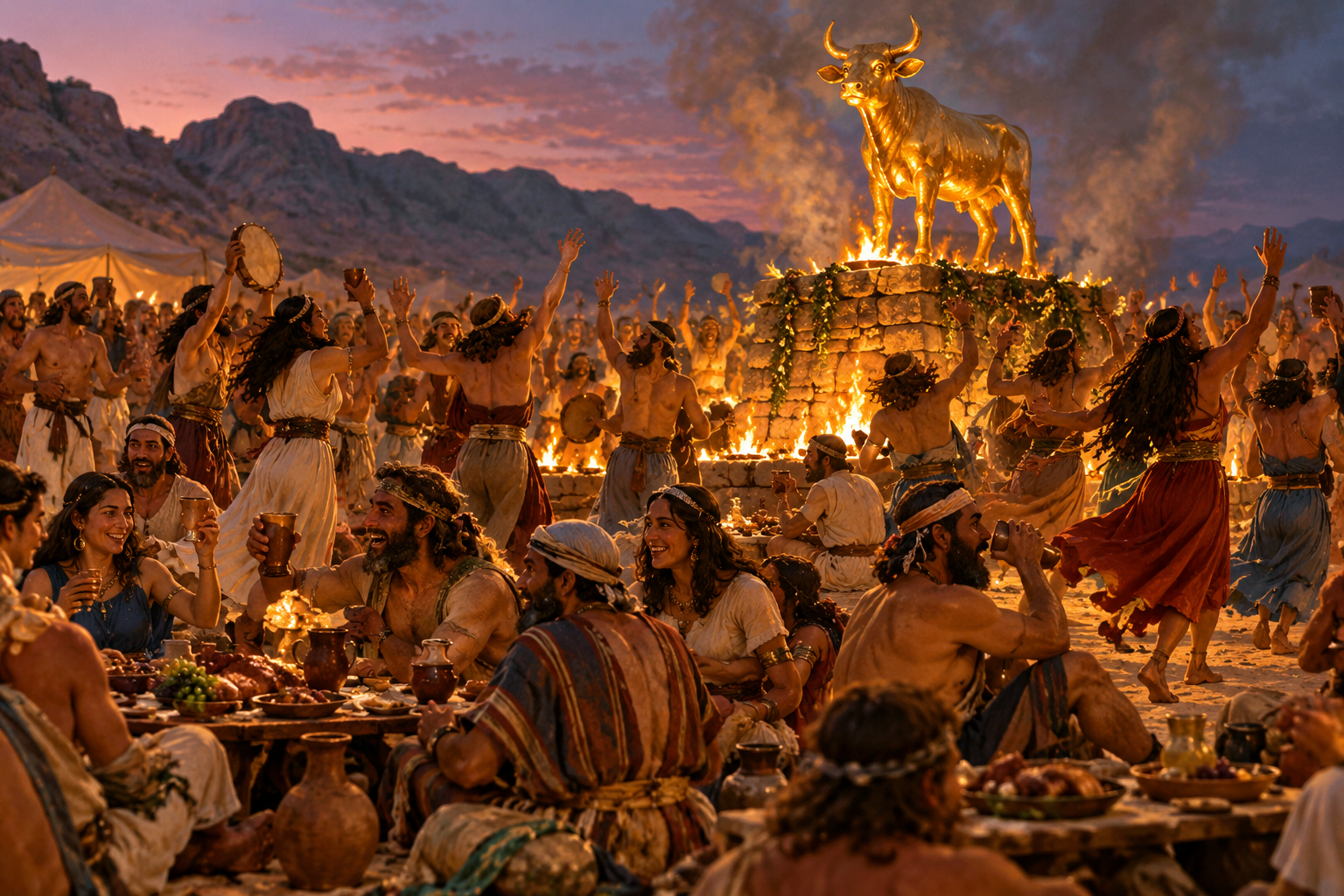
What I shared with the folks at Allen’s Chapel and Mooreville United Methodist Churches on October 11th.
This morning’s text is from Exodus Chapter 32, Verses 1-14:
1When the people saw that Moses delayed to come down from the mountain, the people gathered around Aaron, and said to him, “Come, make gods for us, who shall go before us; as for this Moses, the man who brought us up out of the land of Egypt, we do not know what has become of him.” 2 Aaron said to them, “Take off the gold rings that are on the ears of your wives, your sons, and your daughters, and bring them to me.” 3 So all the people took off the gold rings from their ears, and brought them to Aaron. 4 He took the gold from them, formed it in a mold, and cast an image of a calf; and they said, “These are your gods, O Israel, who brought you up out of the land of Egypt!” 5 When Aaron saw this, he built an altar before it; and Aaron made proclamation and said, “Tomorrow shall be a festival to the LORD.” 6 They rose early the next day, and offered burnt offerings and brought sacrifices of well-being; and the people sat down to eat and drink, and rose up to revel.
7 The LORD said to Moses, “Go down at once! Your people, whom you brought up out of the land of Egypt, have acted perversely; 8 they have been quick to turn aside from the way that I commanded them; they have cast for themselves an image of a calf, and have worshiped it and sacrificed to it, and said, ‘These are your gods, O Israel, who brought you up out of the land of Egypt!’ ” 9 The LORD said to Moses, “I have seen this people, how stiff-necked they are. 10 Now let me alone, so that my wrath may burn hot against them and I may consume them; and of you I will make a great nation.”
11 But Moses implored the LORD his God, and said, “O LORD, why does your wrath burn hot against your people, whom you brought out of the land of Egypt with great power and with a mighty hand? 12 Why should the Egyptians say, ‘It was with evil intent that he brought them out to kill them in the mountains, and to consume them from the face of the earth’? Turn from your fierce wrath; change your mind and do not bring disaster on your people. 13 Remember Abraham, Isaac, and Israel, your servants, how you swore to them by your own self, saying to them, ‘I will multiply your descendants like the stars of heaven, and all this land that I have promised I will give to your descendants, and they shall inherit it forever.’ ” 14 And the LORD changed his mind about the disaster that he planned to bring on his people.
First, let’s make note of how the people refer to Moses as “the man who brought us out of Egypt.”
Just as the people initially wanted to ascribe the healing of the man lame from birth to Peter in the third chapter of Acts, the people of Israel forgot that it was God, not Moses, who delivered them from slavery.
When we turn to the account of the golden calf, that is a good place to start – realizing that the sin that followed was not just about creating an idol but was also the result of forgetting that there is only one God.
One God.
It is unclear whether Israel wanted Aaron to make them a “god: or “gods”. Grammatically, either is possible, since in the Old Testament elohim refers both to one god and multiple gods, depending on context. The NRSV, the NIV, the NABRe and ESV translate verse 4 as the people saying “these are your gods, O Israel, who brought you out of the land of Egypt.” (Emphasis added). The New Jerusalem Bible and the New American Standard Bible translate verse 4 as “This is your god, Israel, who brought you up from the land of Egypt.” (Again, I’ve added the boldface).
For the traditionalists, the King James (or Authorized) version uses the plural “gods,” while the New King James Version elects to use the singular “god.”
So, not only are we confronted with the people’s sin in worshiping a graven image (violating the 2nd Commandment against idol worship), but also in postulating the existence of more than one god (violating the 1st Commandment that there is only one God).
Second, let’s consider the consequence of the people’s sin.
The lesson for the Israelites was harsh – they would not live to see the promised land but they would live, and at least their descendants would enter into the land promised to Abraham, Isaac and Jacob.
Moses interceded when God proposed killing them on the spot, reminding God of God’s promise.
We’re told that God changed his mind and this creates a problem for us because God is eternal and all knowing – so what’s going on?
That’s a mystery, isn’t it?
Third, let’s turn to the lesson of the Golden Calf for us today.
Who or what are the “gods” we place ahead of the one true God?
Who or what are the “idols” we worship in place of God?
Usually, the answer we come up with are material things like a new car, the latest sports equipment, fancy clothing, luxury vacations, fancy furniture, gourmet food, or, for those of us living in northeast Mississippi . . .
Those are all legitimate answers to what I’ll call “Golden Calf Question.”
But I’m going to ask you to think about “AI” — or Artificial Intelligence — instead.
Not what you’d think, is it?
However, odds are you’ve used AI sometime in the past few days if you’ve used Google or some other search engine to look for information on some subject or other.
I used an AI generator to produce the image in the heading of this blog post. I thought about tweaking it to make the Israelites a little less muscular (after all they’d been starved at least a little bit under the Egyptians), but decided to leave it as is). I used another AI application to generate an alternate image but wasn’t too keen on how Aaron came across.
A couple of weeks ago I attended Megapop’s Digital Innovation event. This year the topic was AI with several nationally known speakers on the subject.
You’ve probably read, seen or heard a lot about Artificial Intelligence recently as there have been news reports about AI being a threat to humanity.
Are you frightened?
Are you intrigued?
Are you hopeful?
Do you think that Artificial Intelligence is going to have all the answers to life’s problems. Do you think that AI will come up with a cure the common cold?
In truth, AI is just the latest manifestation of our modern reliance on and belief in science as the be all and end all of the answers to life — a reliance and belief that began with the advent of what Thomas Paine termed the “Age of Reason” in the 18th century. Before that, the world view was based more on faith than reason.
My friend and former college roommate, Don “Buz” Colbert, is a licensed medical doctor, but he also believes in the ultimate healing power of God – the Great Physician.
So do I.
Turning again to AI as the new Golden Calf, there was a recent article in The Economist that reported on OpenAI solving many of the world’s long-standing maths problems. Scientists, mathematicians and others have been studying the solutions with great interest (although they’ve spotted a few problems that might stem from AI “hallucinations”).
The point is that we humans tend to look for a Golden Calf because God — the one God capable of changing God’s mind — is simply beyond our ability to understand from a rational or at least worldly point of view.
Remember my earlier reference to a mystery?
Rudolph Otto wrote about the mystery of the divine, which he called the “numinous” in Das Heilige (The Idea of the Holy) in 1917. He referred to the numinous as the “ganz andere” or “wholly other.” He broke this down into three aspects of the divine:
The Mysterium (Mystery) — the transcendent and incomprehensible nature of the divine that renders us astonished.
The Tremendum (Awe and Dread) — the terrifying and overwhelming presence of the divine. C. S. Lewis wrote movingly of this in the third novel of his Perelandra Trilogy, That Hideous Strength.
The Fascinans (Fascination) — the paradoxical pull of the divine that captivates by its sheer beauty, grace and love.
Try as we might, we can’t fathom the Divine “changing its mind.” No more can we fathom a love that manifested itself in the Word made flesh.
So, we are to choose once again. To choose to yield to our desire to control — to forever feed on the forbidden fruit and make for ourselves yet another Golden Calf; or, paradoxically, to accept that very same first fruit offered to us freely and with loving grace.