What I shared with the folks at Brewer and Shannon United Methodist Churches on June 7th, 2026
1 Now the LORD said to Abram, “Go from your country and your kindred and your father’s house to the land that I will show you. 2 I will make of you a great nation, and I will bless you, and make your name great, so that you will be a blessing. 3 I will bless those who bless you, and the one who curses you I will curse; and in you all the families of the earth shall be blessed.”
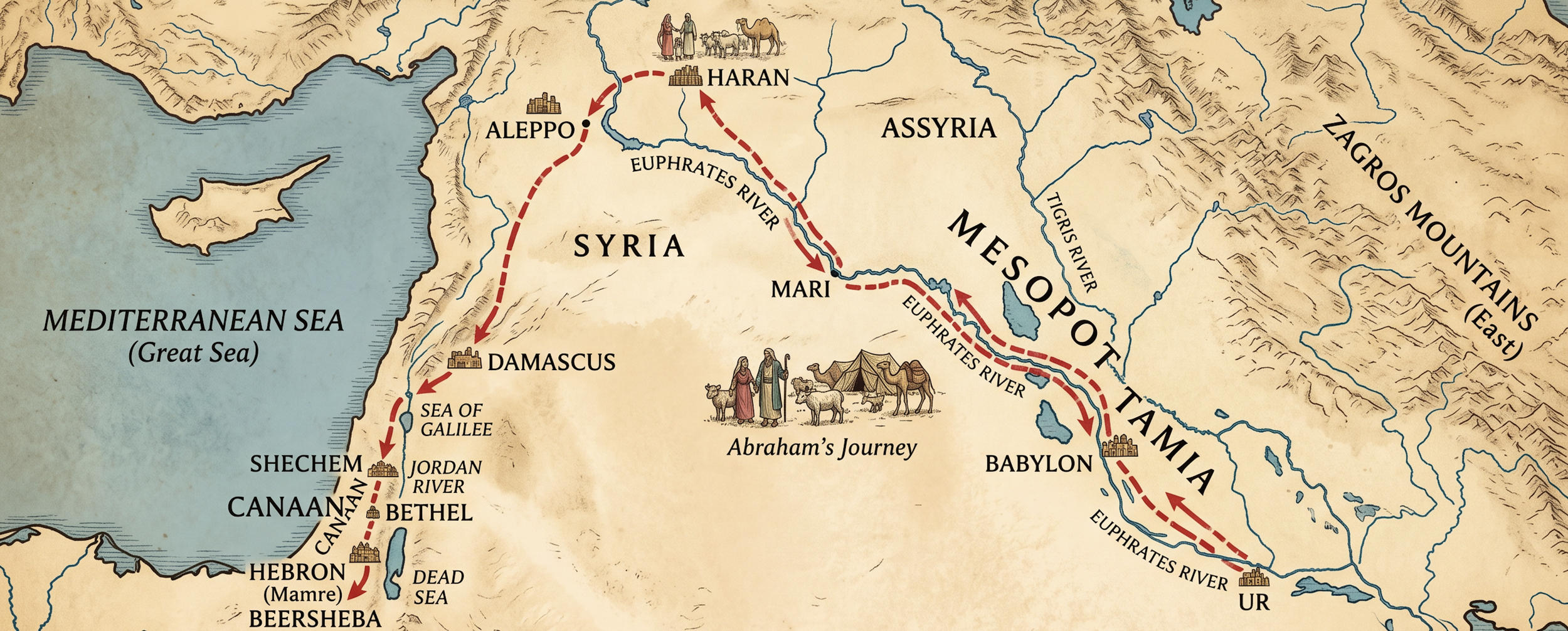
4 So Abram went, as the LORD had told him; and Lot went with him. Abram was seventy-five years old when he departed from Haran. 5 Abram took his wife Sarai and his brother’s son Lot, and all the possessions that they had gathered, and the persons whom they had acquired in Haran; and they set forth to go to the land of Canaan. When they had come to the land of Canaan, 6 Abram passed through the land to the place at Shechem, to the oak of Moreh. At that time the Canaanites were in the land. 7 Then the LORD appeared to Abram, and said, “To your offspring I will give this land.” So he built there an altar to the LORD, who had appeared to him. 8 From there he moved on to the hill country on the east of Bethel, and pitched his tent, with Bethel on the west and Ai on the east; and there he built an altar to the LORD and invoked the name of the LORD. 9 And Abram journeyed on by stages toward the Negeb.
Genesis 12:1-9
This morning our Scripture, taken from the Old Testament, is about “The Call” of Abram. What do we mean by “Call?”
I just returned from the 2026 session of the Mississippi Annual Conference of the United Methodist Church. One of the things that happens every year at the session of the Conference is the service of Ordination. It is a moving service.
The Elders and Deacons, robed in black and wearing their stoles, process into the worship space, led by the bishop and the person, almost always a bishop from another conference, who will deliver the sermon.
And then the ordinands and those who are called go through a liturgy consisting of questions and answers to affirm their ordination or commissioning. Because in our tradition you can’t simply be “ordained” – you have to go through a process. Which is why Jim Jones was never ordained as a United Methodist Elder.
Determining whether or not a person is “called” to full time ministry in the United Methodist Church begins in the local church where the call is discerned by the SPRC (or PPRC, depending on whether the church employs only a pastor). From the local church the process goes through the district, then the conference at which point the candidate has to go through education, residency and examination by the Board of Ordained Ministry (the “BoOM”) consisting of persons (clergy and laity) who review the candidate in detail before recommending that the process continues (for commissioned candidates) or results in ordination.
It ain’t easy.
So, what do we mean by “Call” in the first place?
In the case of Abram, I submit to you that the Call consisted of Mission and Vision.
In the case of the Mississippi Conference of the United Methodist Church, I submit to you that the “Call” also consists of Mission and Vision.
The Mission Statement of the United Methodist Church is “To Make Disciples of Jesus Christ for the Transformation of the World.”
That is our mission.
But what is our vision?
What’s the difference? In the context of the “Call” of Abram, I submit the difference in Mission and Vision can be summarized as follows:
Mission: "What has God called Abram to do"
Vision: "What will the future look like when Abram accomplishes that mission?"
For Abram the Mission was to “Go to the land that God would show him.”
The Vision was to be a blessing -- The focus of the narrative is not who Abram was, but who he will become.
Genealogy – I’ve told y’all before that I’m prohibited from talking about genealogy in my Sunday School class, but here’s the short, short version of Abram’s genealogy:
Abram is descended from Noah (we won’t go into Noah’s ancestry but it goes back to Adam’s son Seth):
Arpachshad [Arphaxad (Son of Shem)],
Shelah,
Eber,
Peleg,
Reu,
Serug,
Nahor,
and thenTerah
Terah
Now these are the descendants of Terah. Terah was the father of Abram, Nahor, and Haran; and Haran was the father of Lot.
Genesis 11:27
Our passage today (Abram’s Call) begins the story of the journey of Abram’s family, for it was originally Terah (Abram’s father) who had intended to go to Canaan. For reasons not explained, he settled the family in Haran in northern Mesopotamia:
“Terah took his son Abram and his grandson Lot son of Haran, and his daughter-in-law Sarai, his son Abram’s wife, and they went out together from Ur of the Chaldeans to go into the land of Canaan; but when they came to Haran, they settled there.”
Genesis 11:31
This enigmatic information about the background of Abram, followed by the abrupt command of God to Abram to depart and then by God’s subsequenr extraordinary blessing of him, gave rise to midrashic speculation. What made Abram worthy of God’s interest in him? What prepared him for the summons from God? These midrashic traditions credited Abram with being the first in his culture and even his family to see the falseness of idols and to worship only God.
While one can understand the desire to fill in the gaps in Abram’s story, Genesis itself seems to be completely uninterested in Abram’s previous character and experiences.
Again, the focus of the narrative is not who Abram was, but who he will become.
For us, the focus is not so much on who we are as United Methodists now (after disaffiliation, Covid and the rest) but on who we will become.
So, what is the Vision of the Mississippi Annual Conference?
2 Then the LORD answered me and said:
Write the vision;
make it plain on tablets,
so that a runner may read it.
3For there is still a vision for the appointed time; it speaks of the end, and does not lie.
If it seems to tarry, wait for it;
it will surely come, it will not delay.
Habakkuk 2:2-3
What’s the difference?
Mission: "What has God called us to do" (To Make Disciples of Jesus Christ for the transformation of the world.)
Vision: "What will the future look like when we accomplish that mission?"
Vision
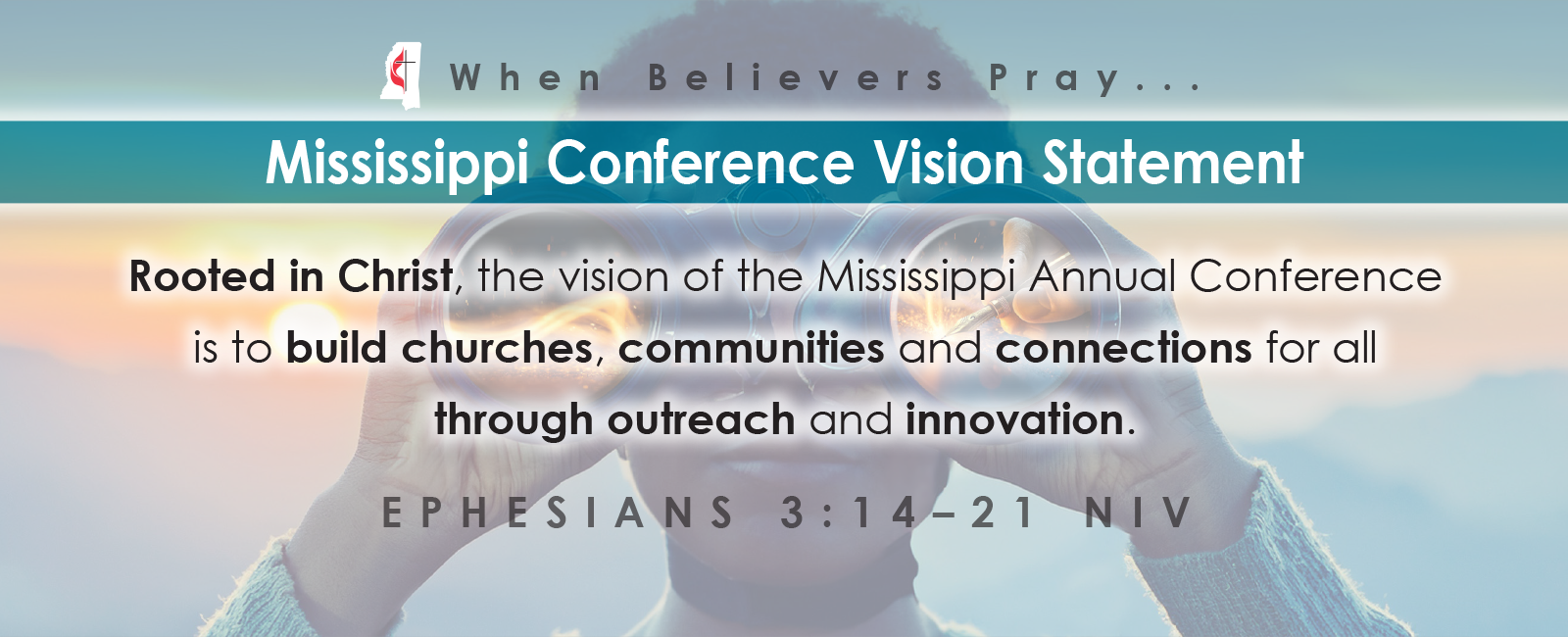
At this year’s session of the Mississippi Annual Conference the new vision (visions need to be renewed from time to time and it’s been twelve years since we last cast a vision for our Conference) was revealed:
Where did this vision come from
from us
It came from the Bishop’s Chat & Chew get togethers, where we told the Bishop what we thought the vision should be. And then . . .
It came from the Bishop’s Vision Task Force, a group of volunteers that took the feedback from those Chat & Chew sessions and met in person and via Zoom over a period of months and distilled your hope and your desire for where the Mission of our church would land us in the coming years.
At Annual Conference I was struck by the vision and the future that was being revealed in two ways:
First, in how we would, like Abram, be a blessing to others through being the hands and feet of Jesus. Through our churches, through the wider community and through our connections (that very Methodist concept) we would be a blessing for ALL through outreach and innovation.
Outreach
Innovation
Second, I was struck by the call that was answered by those who were ordained for service.
And then, I was struck once again by the thread of FAITH that runs from Abram’s setting out through the entire history of the journey of those who followed.
One of my favorite verses, one of the first I memorized, is Hebrews 11:1 – “Faith is the assurance of things hoped for, the conviction of things not seen.”
The 11th chapter of Hebrews is a litany of those called by faith, like Abram (distinguished father) — who became Abraham (the father of many) — called to be a blessing.
By faith Abraham obeyed when he was called to set out for a place that he was to receive as an inheritance; and he set out, not knowing where he was going.
Hebrews 11:8
So, Abram answered the call — the mission to go — the vision to be a blessing. And now we, the United Methodists of Mississippi are also answering our call to fulfill the mission through our common Vision: building Churches, Communities and Connections for All through Outreach and Innovation.