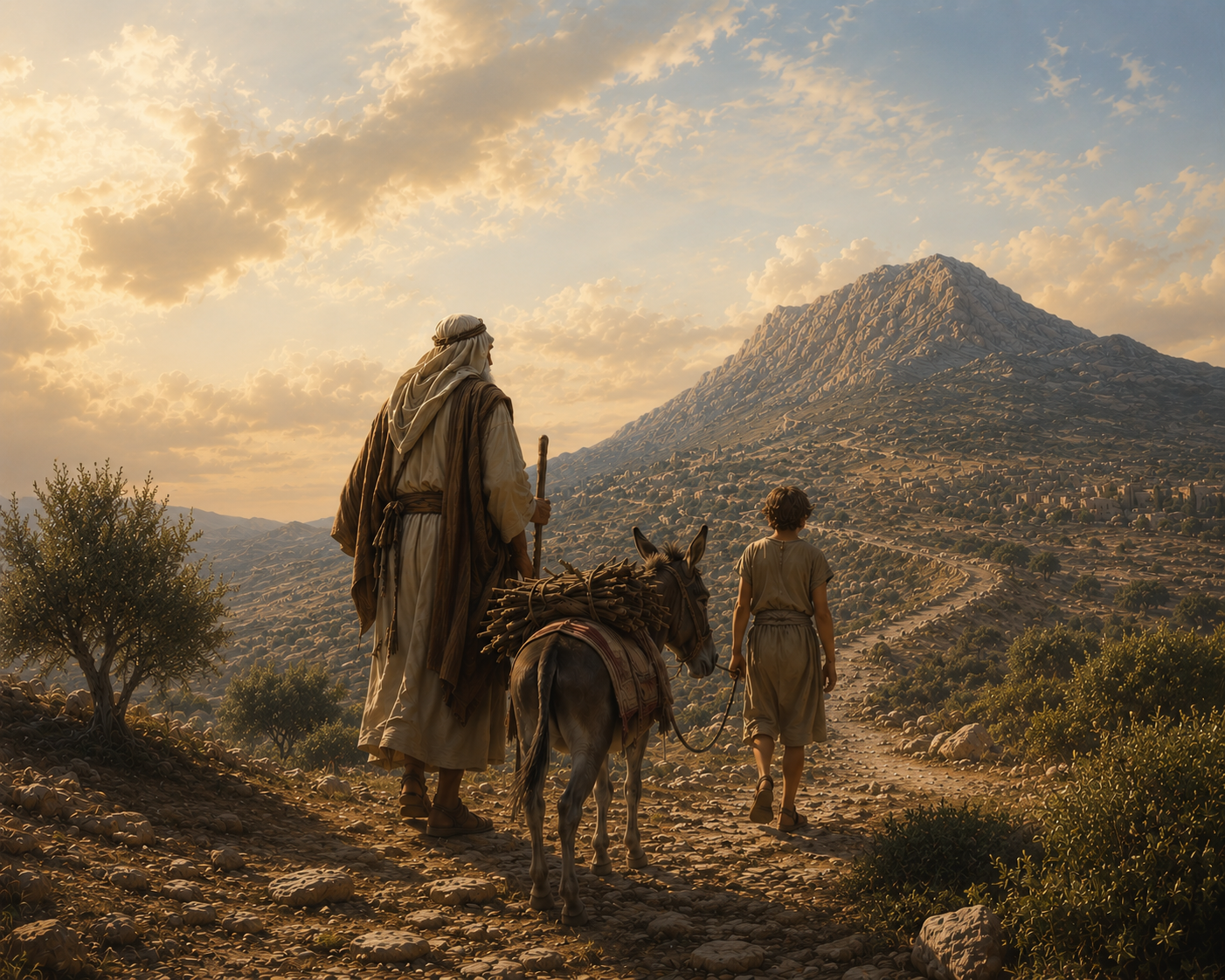
1After these things God tested Abraham. He said to him, “Abraham!” And he said, “Here I am.” 2 He said, “Take your son, your only son Isaac, whom you love, and go to the land of Moriah, and offer him there as a burnt offering on one of the mountains that I shall show you.” 3 So Abraham rose early in the morning, saddled his donkey, and took two of his young men with him, and his son Isaac; he cut the wood for the burnt offering, and set out and went to the place in the distance that God had shown him. 4 On the third day Abraham looked up and saw the place far away. 5 Then Abraham said to his young men, “Stay here with the donkey; the boy and I will go over there; we will worship, and then we will come back to you.” 6 Abraham took the wood of the burnt offering and laid it on his son Isaac, and he himself carried the fire and the knife. So the two of them walked on together. 7 Isaac said to his father Abraham, “Father!” And he said, “Here I am, my son.” He said, “The fire and the wood are here, but where is the lamb for a burnt offering?” 8 Abraham said, “God himself will provide the lamb for a burnt offering, my son.” So the two of them walked on together.
9 When they came to the place that God had shown him, Abraham built an altar there and laid the wood in order. He bound his son Isaac, and laid him on the altar, on top of the wood. 10 Then Abraham reached out his hand and took the knife to kill his son. 11 But the angel of the Lord called to him from heaven, and said, “Abraham, Abraham!” And he said, “Here I am.” 12 He said, “Do not lay your hand on the boy or do anything to him; for now I know that you fear God, since you have not withheld your son, your only son, from me.” 13 And Abraham looked up and saw a ram, caught in a thicket by its horns. Abraham went and took the ram and offered it up as a burnt offering instead of his son. 14 So Abraham called that place “The Lord will provide”; as it is said to this day, “On the mount of the Lord it shall be provided.”
Genesis 22:1-14, NRSV
This is a tough one. It makes you wonder about the nature of God, doesn’t it – that He would ask for such a thing just to test the faith of Abraham.
We need to place this in context. We begin with Abram (“excellent” or “distinguished” father) who answers the call to “go” to a new place. His father was called – we forget that sometimes.
Terah had three sons: Abram, Nahor and Haran, who was the father of Lot. Terah, along with his son Abram (and Abram’s wife Sarah) as well as his grandson, Lot, left Ur which was down near the Persian Gulf in Mesopotamia – the land between the Tigris and Euphrates Rivers.
Terah was supposed to journey to the land of Canaan, but he stopped in Haran (same name as his son, who died before the journey).
Instead, it was Abram who actually answered the call, leaving Haran and journeying south to Canaan.
After a few detours, Abram did wind up in Canaan along with his wife Sarah, and his servant Hagar, with whom he had a child, Ishmael.
I’ve been called myself the last few weeks to go here and there as a lay speaker and so I’ve been following along with Abram in Genesis.
A quick synopsis – Abram answers the call in Genesis chapter 12 – we don’t know much about him other than he acted in faith and went where God told him to go. He was told he would be a blessing to generations to come but he questioned God – how could he be a blessing to future generations if he had no heir?
In Chapter 15 God promised Abram he would have as many descendants as there were stars in the sky and Abram believed God and God “reckoned it to him as righteousness.”
He acted in faith when God called upon him to seal the covenant through circumcision in Chapter 17, he stood firm in faith though Sarah laughed when the three angels repeated the promise in Chapter 18 and so the promised child was named “Isaac” or “Yitsahk” (he laughed).
He was told that the promise would be through Sarah and so he didn’t make Ishmael, the son of the servant woman, Hagar, his heir, but waited for Isaac. (Ishmael means God hears), but when Hagar and Ishmael were driven away by Sarah, they were saved by God from dying of thirst because God saw them and showed Hagar the spring of water and Hagar called God “El-Roi” the God who “sees.”
So, when the promised child does arrive we wonder why God asks this terrible thing of Abraham – that he sacrifice his son (we can talk about the vision of Abraham in chapter 15 and how that foreshadows what God will do through Christ, but not this morning – we’re limited by time).
Walter Brugguemann in his commentary on Genesis emphasizes verse 8 – Abraham’s faith that God will provide a sacrifice.
Abraham said, “God himself will provide the lamb for a burnt offering, my son.” So the two of them walked on together.
Genesis 22:8
In addition to genealogy, one of the things that interests me is etymology. The source of our word “provide” comes from the Latin “pro-video” to “see before” or to “see to” – you see why I mentioned Hagar and El-Roi (the God who sees) now.
God sees our need and God answers that need.
God tests and God provides. Why does he test?
Brueggemann says that most Faithful people will be tempted to want only half of it. Most complacent religion will want a God who provides, not a God who tests.
God will test, but God will provide.
Jesus taught us to pray about this, didn’t he?
Our Father, who art in heaven,
hallowed be thy name;
thy kingdom come,
thy will be done
on earth as it is in heaven.
Give us this day our daily bread,
and forgive us our trespasses,
as we forgive those who trespass against us;
and lead us not into temptation,
but deliver us from evil.
In the prayer he taught us he knew we would require provision and that we would face testing. Do you see it?
Our Father, who art in heaven,
hallowed be thy name;
thy kingdom come,
thy will be done
on earth as it is in heaven.
Give us this day our daily bread (provision),
and forgive us our trespasses,
as we forgive those who trespass against us;
and lead us not into temptation (testing),
but deliver us from evil.
Faith
Faith is the assurance of things hoped for, the conviction of things not seen.
Hebrews 11:1
I’ve struggled with the concept of faith, and I still struggle with the concept of faith.
Today, I’m going to suggest to you that the opposite of faith is not doubt. Instead it is what doubt leads to that is the opposite, or rejection of faith:
Denial
Deceit
Despair
Denial
Instead of saying “God will provide”, Abraham says to himself, “God doesn’t intend for me to sacrifice Isaac, so we’ll turn back – God will understand”.
Instead of manifesting our love of neighbor by giving to the ministries of the church, or the Salvation Army or Sanctuary Hospice House or any other charity, we decide to leave “provision” to God – we fail the test.
Deceit
Instead of binding Isaac, Abraham pretends to bind him while secretly looking for a substitute and, finding none, says to himself, “God didn’t mean it” or worse, “I’ll sacrifice Ishmael instead.”
Instead of fulfilling our pledge to the Boy Scouts or to the church or to whatever promise we’ve made, we cheat by claiming that changed circumstances (the new car, the trip to the beach, the fancy restaurant) lets us off the hook – we fail the test.
Despair
Abraham turns from God.
We turn from God – we fail the test
The test of Abraham is so troubling because it is so unlike our understanding of a loving God. But the test was so great because the faith of Abraham was so great. At least that’s my thinking.
Our faith doesn’t match that of Abraham (or of Joan of Arc or Mother Teresa or some other “saint”). Our tests are the small tests of everyday life: ignoring the cry of the needy, cheating a little on reporting income, deciding to not tip the waiter or waitress.