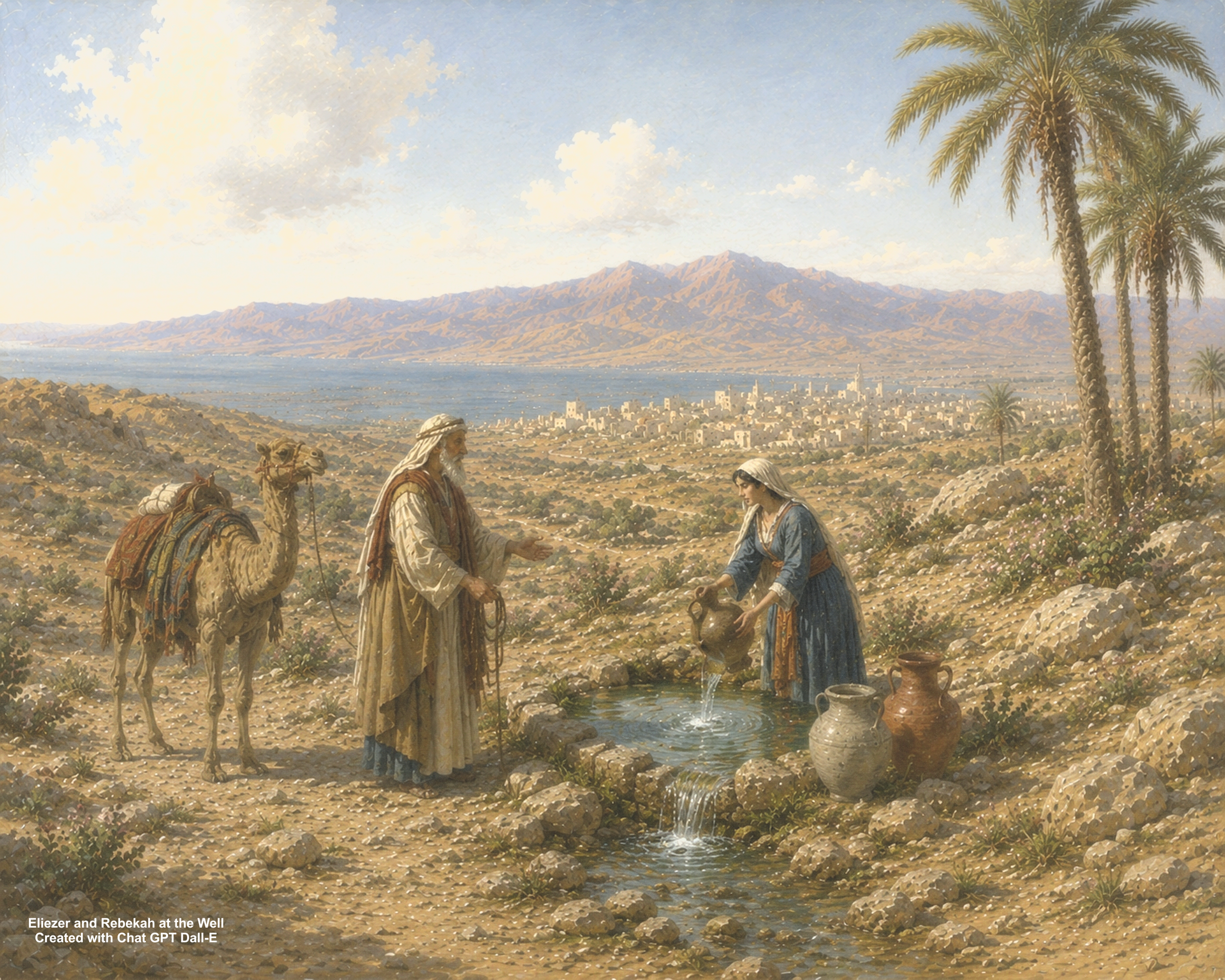
34So he said, “I am Abraham’s servant. 35 The Lord has greatly blessed my master, and he has become wealthy; he has given him flocks and herds, silver and gold, male and female slaves, camels and donkeys. 36 And Sarah my master’s wife bore a son to my master when she was old; and he has given him all that he has. 37 My master made me swear, saying, ‘You shall not take a wife for my son from the daughters of the Canaanites, in whose land I live; 38 but you shall go to my father’s house, to my kindred, and get a wife for my son.’
42 “I came today to the spring, and said, ‘O Lord, the God of my master Abraham, if now you will only make successful the way I am going! 43 I am standing here by the spring of water; let the young woman who comes out to draw, to whom I shall say, “Please give me a little water from your jar to drink,” 44 and who will say to me, “Drink, and I will draw for your camels also”—let her be the woman whom the Lord has appointed for my master’s son.’
45“Before I had finished speaking in my heart, there was Rebekah coming out with her water jar on her shoulder; and she went down to the spring, and drew. I said to her, ‘Please let me drink.’ 46 She quickly let down her jar from her shoulder, and said, ‘Drink, and I will also water your camels.’ So I drank, and she also watered the camels. 47 Then I asked her, ‘Whose daughter are you?’ She said, ‘The daughter of Bethuel, Nahor’s son, whom Milcah bore to him.’ So I put the ring on her nose, and the bracelets on her arms. 48 Then I bowed my head and worshiped the Lord, and blessed the Lord, the God of my master Abraham, who had led me by the right way to obtain the daughter of my master’s kinsman for his son. 49 Now then, if you will deal loyally and truly with my master, tell me; and if not, tell me, so that I may turn either to the right hand or to the left.”
58 And they called Rebekah, and said to her, “Will you go with this man?” She said, “I will.” 59 So they sent away their sister Rebekah and her nurse along with Abraham’s servant and his men. 60 And they blessed Rebekah and said to her,
“May you, our sister, become
thousands of myriads;
may your offspring gain possession
of the gates of their foes.”
61 Then Rebekah and her maids rose up, mounted the camels, and followed the man; thus the servant took Rebekah, and went his way.
62 Now Isaac had come from Beer-lahai-roi, and was settled in the Negeb. 63 Isaac went out in the evening to walk in the field; and looking up, he saw camels coming. 64 And Rebekah looked up, and when she saw Isaac, she slipped quickly from the camel, 65 and said to the servant, “Who is the man over there, walking in the field to meet us?” The servant said, “It is my master.” So she took her veil and covered herself. 66 And the servant told Isaac all the things that he had done. 67 Then Isaac brought her into his mother Sarah’s tent. He took Rebekah, and she became his wife; and he loved her. So Isaac was comforted after his mother’s death.
Genesis 24:34-38, 42-49, 58-67, NRSV
Here we find Isaac, through a servant of Abraham, finding a wife that is not a Canaanite. We’re not told the name of the servant here or elsewhere in Chapter 24. The consensus of scholars is that this is likely Eliezer mentioned in Genesis 15:2, in which Abram (not yet Abraham), laments that he continues childless having no heir other than his steward, Eliezer of Damascus.
Regardless, this unnamed servant travels back to Nahor in Haran, from whence Abraham came, and finds there Rebekah, who was born to Bethuel son of Milcah (a daughter of Haran, a brother of Abraham), the wife of Nahor, another brother of Abraham.
The impetus for this was to keep the Aramaic bloodline pure, unsullied by the native Canaanites.
Two View Points to Reflect Upon
There are two aspects of the passages concerning Rebekah and Isaac that I suggest we consider:
The first is the faithfulness of Abraham’s servant who is “led” to the place where he will find the future bride of Isaac. See, 24:26-27 — in which he bows his head, praying, “Blessed be the Lord, the God of my master Abraham, who has not forsaken his steadfast love and his faithfulness toward my master. As for me, the Lord has led me on the way to the house of my master’s kin.”
Walter Brueggemann notes that the use of the term “led” (Hebrew נחה — “nāḥāh) merits special significance:
Use of the guidance motif is worth special attention. The term nāḥāh (RSV, “led”) occurs nowhere else in Genesis. Its two characteristic uses refer (a) to guidance in the wilderness sojourn (Exod. 13:17; Ps. 60:9; 78:14; 53; 108:10), and (b) to personal well-being as a request in time of stress (see especially the Psalms of lament, 5:8; 27:11; 31:3; 43:3; 73:24). Surely the best known usage is Ps. 23:2–3 which is a statement of utter confidence in God’s benevolent care:
He leads me beside still waters;
he restores my soul.
He leads me in paths of righteousness
for his name’s sake. (author’s italics)
Brueggemann, W. (1982). Genesis (p. 200). John Knox Press.
The other aspect that occurred to me as I was preparing for this meditation was the news coverage of the march by Patriot Front, of men in white masks marching and chanting “Reclaim America” – from foreigners. I don’t bring this up to reflect on the politics of the group – I really haven’t given them that much thought.
But it did occur to me that people – including Abraham and Isaac – want to gather with people who look and act like them. They want to preserve the tribal or family unit in other words. Which is odd when you stop and think about it because humanity is essentially one species.
This basic human tendency shows up here in the story of Isaac and Rebekah, and it’ll show up again in the story of Jacob who will also return to find a wife among “his people” – returning with Leah and Rachel.
But we are all one as far as God is concerned.
I’d like to think that that’s something we need to remember and reflect upon on this 250th anniversary of the Declaration of Independence.
God Sees
First, let’s look at where Isaac comes from to meet Rebekah (and where he ends up settling) -- Beer-Lahai-Roi, which means the well of the “living one” (El) who sees me.
That location wasn’t named by Abraham, or Sarah, or Isaac. It was named by the servant woman, Hagar (an Egyptian woman), who was driven away at the insistence of Sarah, who didn’t want Abraham’s son by Hagar, Ishamel, to compete with Isaac.
So, Isaac and Rebekah settle in a location named by a woman who was a foreigner and a servant (in other words a slave).
God does have a sense of humor. A man named Isaac, “God Laughs”, settles in a place named by the servant mother of his half-brother, Ishmael, “God Hears”.
Communion
Which leads us to communion:
I decided to bake bread for the folks at Allen’s Chapel and Mooreville United Methodist Churches. I’m not ordained and so even though I would lead those congregations in The Great Thanksgiving, I asked our District Superintendent, Lynn Mote, to consecrate the elements. I had the “wine” (Welch’s Grape Juice), but I didn’t have the bread yet. Instead, I had the wheat from which I would mill the flour for the bread.
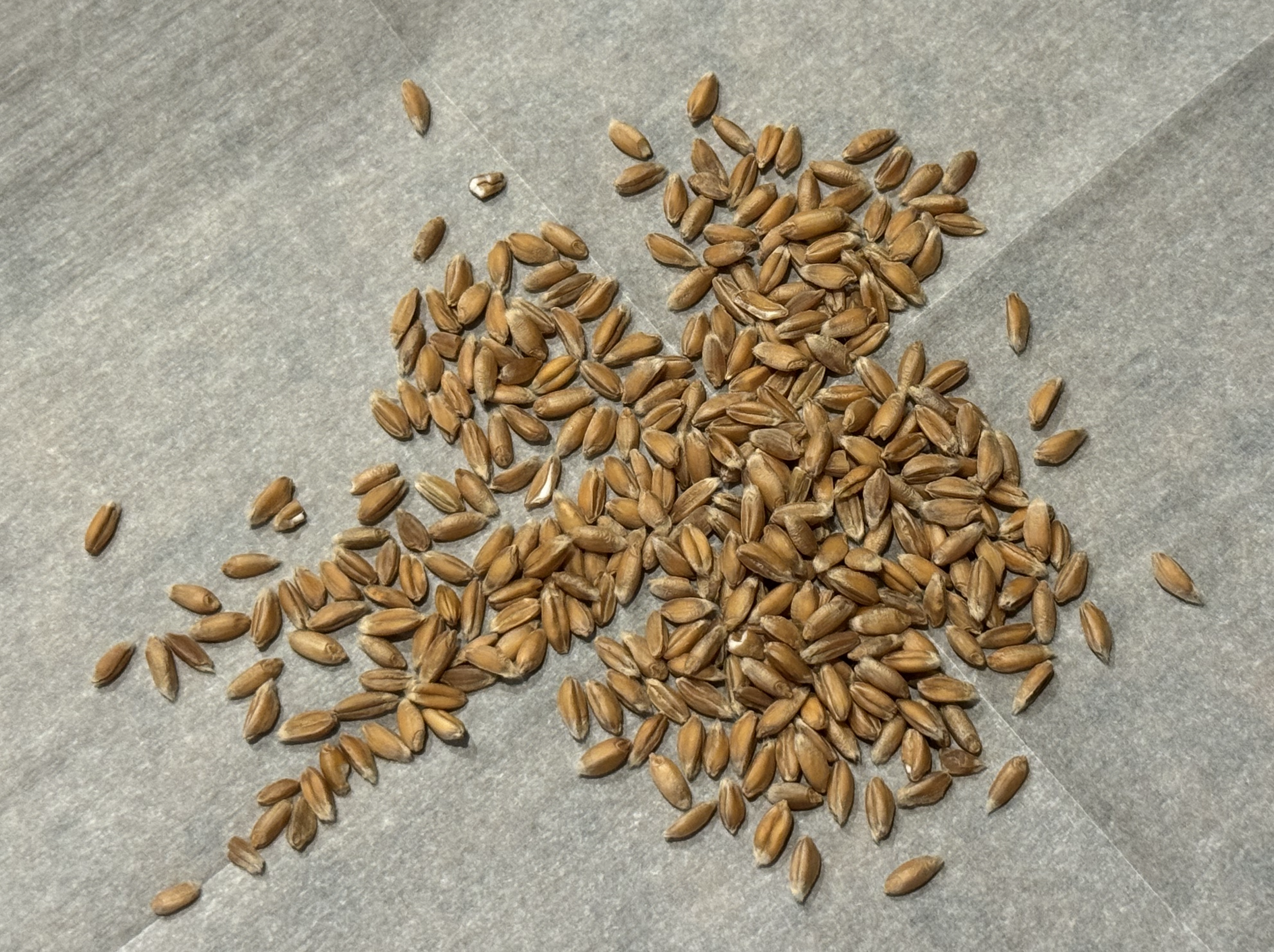
The wheat that I chose was a combination of Emmer and Spelt wheat berries — those ancient grains are the varieties of wheat that Jesus would have used in his parables and in the bread which he shared with his disciples. Lynn was gracious enough to agree to consecrate the wheat from which the bread would ultimately be baked. I milled the wheat berries and used the resulting “whole grain” to produce loaves for both churches as well as an extra one.
For those interested in the art of baking, I used a “no-knead” method with 1,000 grams of the milled wheat berries, 750 grams of water (actually, a little more because whole grains absorb more water), 75 grams of my rye-based leavening (sourdough starter), and 20 grams of salt.
We used the small individual cups of juice along with pieces of bread torn from the loaves at Allen’s Chapel and the method of “intinction” at Mooreville, where the people dipped the pieces of the loaves in a chalice holding the juice.
What follows is essentially the Service of Word and Table III from the United Methodist Hymnal –
The Lord be with you.
And also with you.
Lift up your hearts
We lift them up to the Lord.
Let us give thanks to the Lord our God.
It is right to give our thanks and praise.
It is right, and a good and joyful thing, always and everywhere to give thanks to you, Father Almighty, creator of heaven and earth. You formed us in your image and breathed into us the breath of life. When we turned away, and our love failed, your love remained steadfast.
You delivered us from captivity, made covenant to be our sovereign God, and spoke to us through the prophets. And so,with your people on earth and all the company of heaven we praise your name and join their unending hymn:
Holy, holy, holy Lord, God of power and might, heaven and earth are full of your glory. Hosanna in the highest. Blessed is he who comes in the name of the Lord. Hosanna in the highest.
Holy are you, and blessed is your Son Jesus Christ.
Your Spirit anointed him
to preach good news to the poor,
to proclaim release to the captives
and recovering of sight to the blind,
to set at liberty those who are oppressed,
and to announce that the time had come
when you would save your people.
He healed the sick, fed the hungry, and ate with sinners.
By the baptism of his suffering, death, and resurrection
you gave birth to your Church,
delivered us from slavery to sin and death,
and made with us a new covenant
by water and the Spirit.
When the Lord Jesus ascended,
he promised to be with us always,
in the power of your Word and Holy Spirit.
On the night in which he gave himself up for us, he took bread, gave thanks to you, broke the bread, gave it to his disciples, and said: "Take, eat; this is my body which is given for you. Do this in remembrance of me."
When the supper was over, he took the cup, gave thanks to you, gave it to his disciples, and said: "Drink from this, all of you; this is my blood of the new covenant, poured out for you and for many for the forgiveness of sins. Do this, as often as you drink it, in remembrance of me."
And so, in remembrance of these your mighty acts in Jesus Christ, we offer ourselves in praise and thanksgiving as a holy and living sacrifice, in union with Christ's offering for us, as we proclaim the mystery of faith.
Christ has died; Christ is risen; Christ will come again.
Pour out your Holy Spirit on us gathered here, and on these gifts of bread and wine. Make them be for us the body and blood of Christ, that we may be for the world the body of Christ, redeemed by his blood.
By your Spirit make us one with Christ, one with each other, and one in ministry to all the world, until Christ comes in final victory and we feast at his heavenly banquet.
Through your Son Jesus Christ, with the Holy Spirit in your holy Church, all honor and glory is yours, almighty Father, now and forever. Amen.
And now, with the confidence of children of God, let us pray:
THE LORD’S PRAYER
Our Father, who art in heaven,
hallowed be thy name;
thy kingdom come,
thy will be done
on earth as it is in heaven.
Give us this day our daily bread,
and forgive us our trespasses,
as we forgive those who trespass against us;
and lead us not into temptation,
but deliver us from evil.
For thine is the kingdom,
the power, and the glory,
forever. Amen
One Loaf
Because there is one loaf, we, who are many, are one body, for we all partake of the one loaf.
The bread which we break is a sharing in the body of Christ.
The cup over which we give thanks is a sharing in the blood of Christ.