Thoughts I shared with Allen’s Chapel and Mooreville United Methodist Churches on the occasion of Allen’s Chapel’s Memorial service on August 9th 2026.
I haven’t discovered kinfolk in Gilvo Cemetery at Allen’s Chapel . . . yet
1 Now faith is the assurance of things hoped for, the conviction of things not seen. 2 Indeed, by faith our ancestors received approval. 3 By faith we understand that the worlds were prepared by the word of God, so that what is seen was made from things that are not visible.
Hebrews 11:1-3
13All of these died in faith without having received the promises, but from a distance they saw and greeted them. They confessed that they were strangers and foreigners on the earth, 14 for people who speak in this way make it clear that they are seeking a homeland. 15 If they had been thinking of the land that they had left behind, they would have had opportunity to return. 16 But as it is, they desire a better country, that is, a heavenly one. Therefore God is not ashamed to be called their God; indeed, he has prepared a city for them.
Hebrews 11: 13-16
1Therefore, since we are surrounded by so great a cloud of witnesses, let us also lay aside every weight and the sin that clings so closely, and let us run with perseverance the race that is set before us, 2 looking to Jesus the pioneer and perfecter of our faith, who for the sake of the joy that was set before him endured the cross, disregarding its shame, and has taken his seat at the right hand of the throne of God.
Hebrews 12:1-2
First thing I want to talk about is the cloud. Not the cloud of witnesses . . . but “the cloud” that people talk about in tech terms. It takes shape in various forms and under various names. I use Dropbox a lot myself, but I also use Microsoft’s OneDrive.
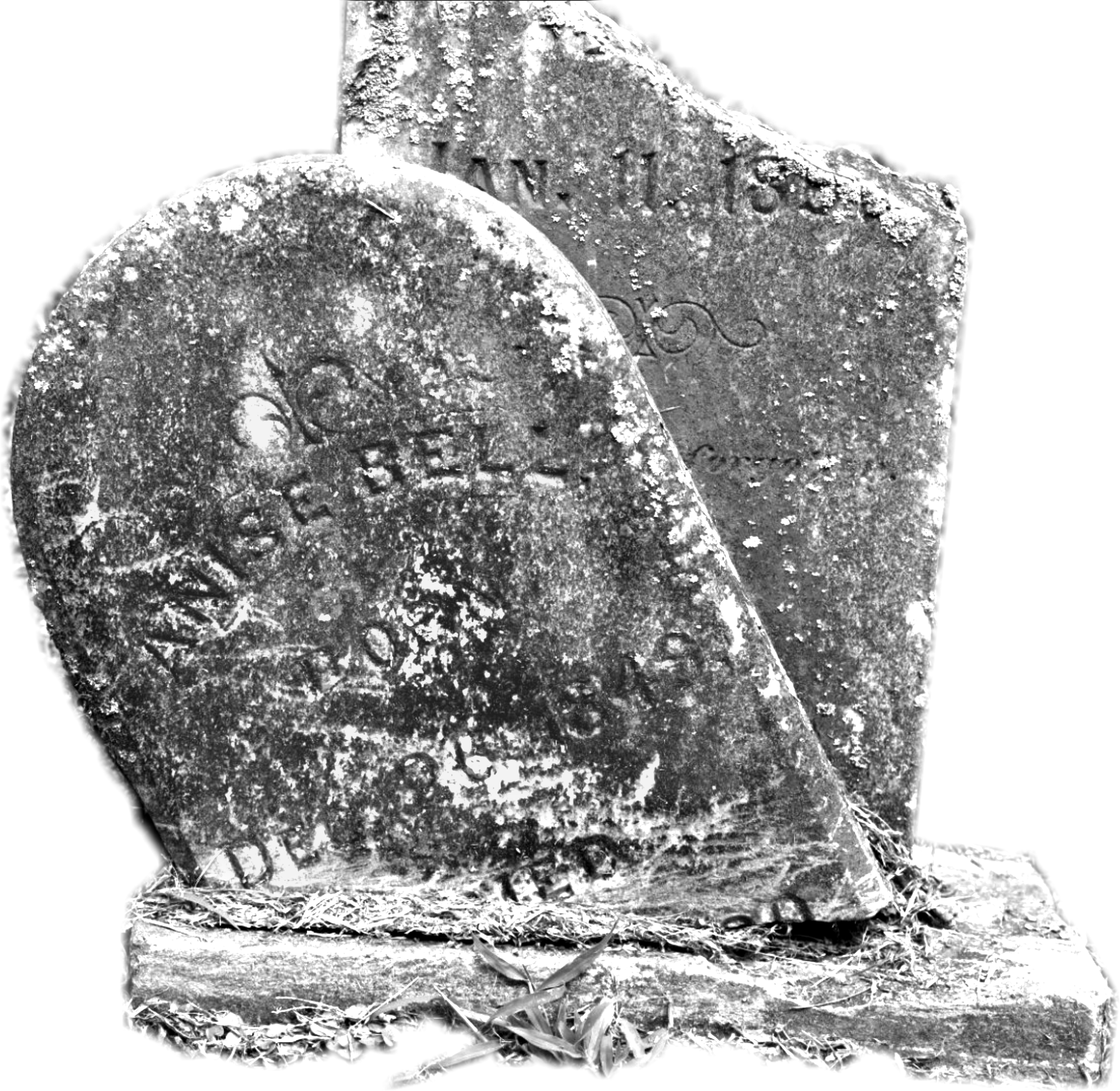
The reason I bring it up is that I get an email from the OneDrive “cloud” each day with “Memories” – photos and images that I’ve stored in the cloud. I’m not really sure how OneDrive selects them but this past Tuesday, August 4th, as I began thinking of what I’d have to say to you today, the images that popped up in my email included the one that’s on the cover of your Bulletin.
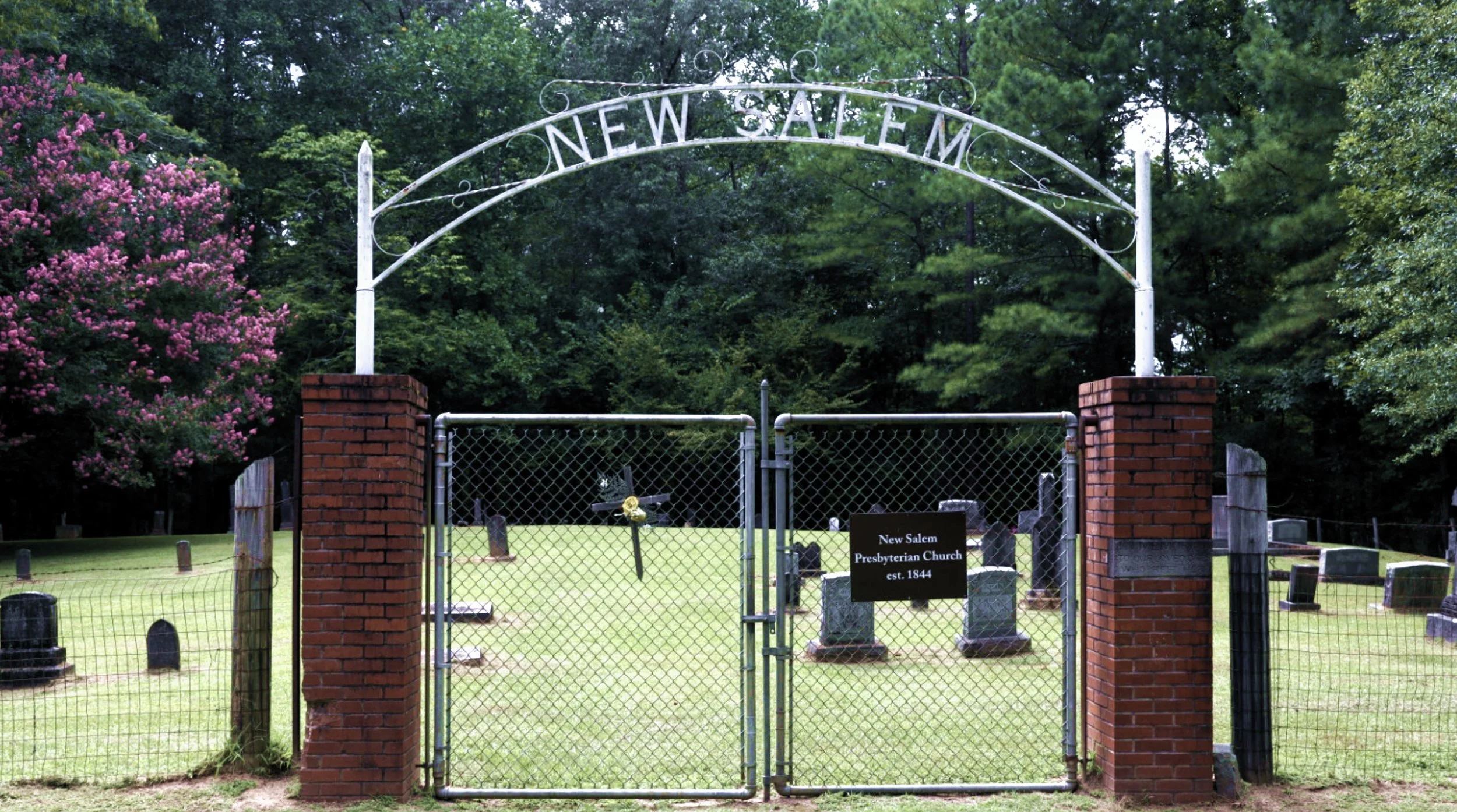
It wasn’t a grayscale image, but instead was a color photo of the broken headstone of Sarah Anise Huntsman Bell that I’d taken with my iPhone of the broken headstone of Sarah Anise Huntsman Bell in the New Salem cemetery in south Pontotoc County just north of the Chickasaw county line. I also took a photo of the gate and fence surrounding that small cemetery. The church of the same name that used to be there is no longer there, but the headstones endure.
As do the memories of those gone before
The reason I took that photo was because of my law partner, Mike Tapscott. You see, Anise (born in western Missouri in 1849, died in Chickasaw County, Mississippi in 1890) was his great grandmother. Back on August 4th, 2019, I was helping Mike build his tree on Ancestry.com. He knew most of the names of his ancestors, but I was helping him organize them into a family tree on Ancestry.
One of the things I discovered that Mike didn’t know was that Sarah Anise from Johnson County in western Missouri, just west of Kansas City. A distant relative of Mike who still lives in that area sent me a bunch of information about that Missouri connection. Made me wonder about where her family may have stood when war broke out between the states. How did she end up in Chickasaw County? Her husband, William James Bell, 10 years older, was from Tennessee. Did he also move south because of the war between the states?
Anyway, on that same August day that I visited New Salem cemetery, I drove further south to Okolona, where I visited Oddfellows cemetery. That’s where Mike’s great-great grandparents, Martin Thomas Foy and Anna Ellis Foy are buried along with their daughter (Mike’s great grandmother), Ella Foy, who married Mike’s great grandfather, John F. Lyons. Anna Ellis’s mother was born in Ireland, as was John Lyons’ father (born 1824, arrived in the United States in New Orleans in 1847).
The New Basin Canal was constructed by the New Orleans Canal and Banking Company. The intent was to build a shipping canal from Lake Pontchartrain through the swamp land to the booming uptown or "American" section of the city, to compete with the existing Carondelet Canal in the downtown Creole part of the city.
Yellow fever ravaged workers in the swamp in back of town. Because the loss of slaves was judged too expensive, most of the work was performed by Irish immigrant laborers. The Irish workers died in great numbers, but the Company had no trouble finding more men to take their place, as shiploads of poor Irishmen arrived in New Orleans. Many were willing to risk their lives in hazardous, back-breaking work for a chance to earn $1 a day. No official count was kept of the deaths of the Irish worker, but 8,000 is a commonly cited total. Many were buried without a grave marker in the levee and roadway-fill beside the canal. There are no headstones for those immigrants, but their memory endures in the descendants of those who survived.
Mike’s great-great grandfather, Martin Thomas Foy (born in Ireland in November 1836), on the other hand arrived in New York when he emigrated to the U.S. with his parents when he was five years old. His family settled in Illinois but in 1855, he came south to Tennessee and served in the confederate army in the Civil War. Afterwards he married in 1865 and moved to Kossuth and eventually to Okolona.
My great-great grandmother, Katherine “Kate” O’Brien, born in Ireland in 1834 and married to my German immigrant great-great grandfather, Aloysius Kaneft, in Galesburg, Illinois, is listed by the maiden name “Lyons” in the Saint Mary’s cemetery in Galesburg – the immigration officials listed a lot of Irish immigrants with the surname “Lyons” because they couldn’t make out the Gaelic names of the arrivals.
One more graveyard story about Mike. His sister, Dorothy “Dot” Tapscott (1947-2010) never married. She lived in Baton Rouge and when she passed away, Mike and his wife, Marsha, went down there to take care of her possessions. One of those things were the cremains of her dogs.
Mike and Marsha brought the little urns with those canine ashes back to be buried with her in the cemetery here in North Mississippi. Imagine their chagrin when they later discovered one of the canine ashes had not made it into the grave.
They placed the urn in a place of honor on the mantle in their living room, but it all but cried out to be reunited with Dot and the other dogs. So, Mike, with Marsha serving as lookout, went to her grave and dug down far enough to inter the last pup with his sister.
Speaking of digging in graveyards, my father’s first cousin, William Walter Wicker (1930-2021), who lived in Louisiana, was cremated and buried both in Texas (where his daughter lives) and in Pisgah Cemetery in Benton County (the church, that Caswell Drake Wicker built, was destroyed by fire years ago, but the cemetery remains).
As do the memories of those gone before
Several of us went to the interment at Pisgah and turned out that the “grave” for Walter was in the wrong place. No problem: the lady who helps maintain the cemetery came up with a post hole digger and remedied the problem.
My friend, Bill Williams, can trace his line back to the McGregor family in Scotland, who fought against the British for Scottish independence. Bill located the grave of his ancestor, William A Williams (1801-1873) in Sanford, Covington County, Alabama. William A. Williams was born in Chester, South Carolina, which was a place where many immigrants lived in the 1700’s, including my ancestor, Peter Wylie.
Peter Wylie (born in Antrim, Northern Ireland in 1711) immigrated to Chester County in South Carolina in 1767, along with his children, one of whom, James Wylie (1748-1825) met his future wife, Sarah Campbell (1749-1810) on board the ship from Ireland. The Wylie’s and Campbells came from Scotland before they lived in Ireland — they were part of the numerous “Scotch-Irish” that came in great numbers to America.
Their son, Duncan Wylie, Sr. (1783-1840) is one of my 4th great grandfathers. He’s buried in Chester County. He had a falling out with his eldest son, Duncan Wiley, Jr., who left and moved to Alabama and ultimately to Mississippi, where he settled in Tippah County.
After his death, Duncan Wylie Sr’s wife, Sarah Martin (1785-1864) moved with several of her children to what is now Chesterville in Pontotoc County. She’s buried in a cemetery near one of the flood control structures maintained by Town Creek Master Water Management District along with some of her children. Her headstone is lost. I’d like to get the folks at Ole Miss who do ground penetrating radar to maybe come find her so we can erect a headstone. Even so, those without headstones are still remembered.
My great-great grandmother, Rebecca Sanford, is buried in Pleasant Hill cemetery in Union County, Mississippi. Some of the family visit her grave from time to time as well as that of my great-great grandfather, William Jasper Vawter.
Rebecca and William Jasper’s grandson, Olice Jasper, died in WWII in the Pacific when the Enoura Maru, the prisoner of war ship on which he was being transferred during the Japanese retreat from island to island, was sunk by Allied planes near the end of the war. Olice had survived the Bataan Death March and the horrors of the Japanese POW camp only to die days before he would have been liberated. My uncle Fred (who was in Germany in WWII) used to say “Ole Olice, he almost made it.” There’s no marker for Olice, but his memory endures.
As do the memories of those gone before
Some of us also visit the grave of my great-great grandfather, Caswell Drake Wicker, who’s buried in a graveyard near Potts Camp that has been overgrown with pines, sweetgum and privet. Caswell Drake was the one who built the church at Pisgah that burned. He was also at Gettysburg and took part in Pickett’s ill-fated charge.
You have to know where to stop along old highway 78 to find the path that goes up a hill to find Caswell Drake’s small marker along with the that of my great-great grandmother, Mary Eugunia Utley.
A little while back, my cousin Roger and I were returning from some family property in south Pontotoc County, when we stopped along Highway 41 just north of the Natchez Trace Parkway and visited the site of the graves of 11 unknown Union soldiers who died during the Civil War Battle of Okolona. We found and replaced the flags that had fallen – I guess from the weather. We only found ten. I need to go back and take a flag for the eleventh soldier. We don’t know their names, but we remember them nonetheless.
One last thing before I finish – Cleaning headstones:
There are several articles on the internet that can help with this – one that’s good is at https://markersandheadstones.com/blogs/news/how-to-clean-maintain-a-headstone-or-grave-marker
I said headstone cleaning was one last thing, but there’s one more. As we remember those who have gone before, we need to remember Francis Asbury and Tobias Gibson, two of the men who came to America to promote Methodism. They were circuit riders and one of the places that Tobias Gibson came and established a church was Natchez in 1799, at a time when Mississippi was still a territory. Though Tobias had no children, he is considered the father of Methodism in Mississippi and he does have a relative alive today to help us remember him – the Rev. Lynn Mote, our own current District Superintendent, who delivered the message here last Sunday.
How’s that for Methodist connections?