The message I shared with the folks at Brewer and Shannon United Methodist churches this Sunday.
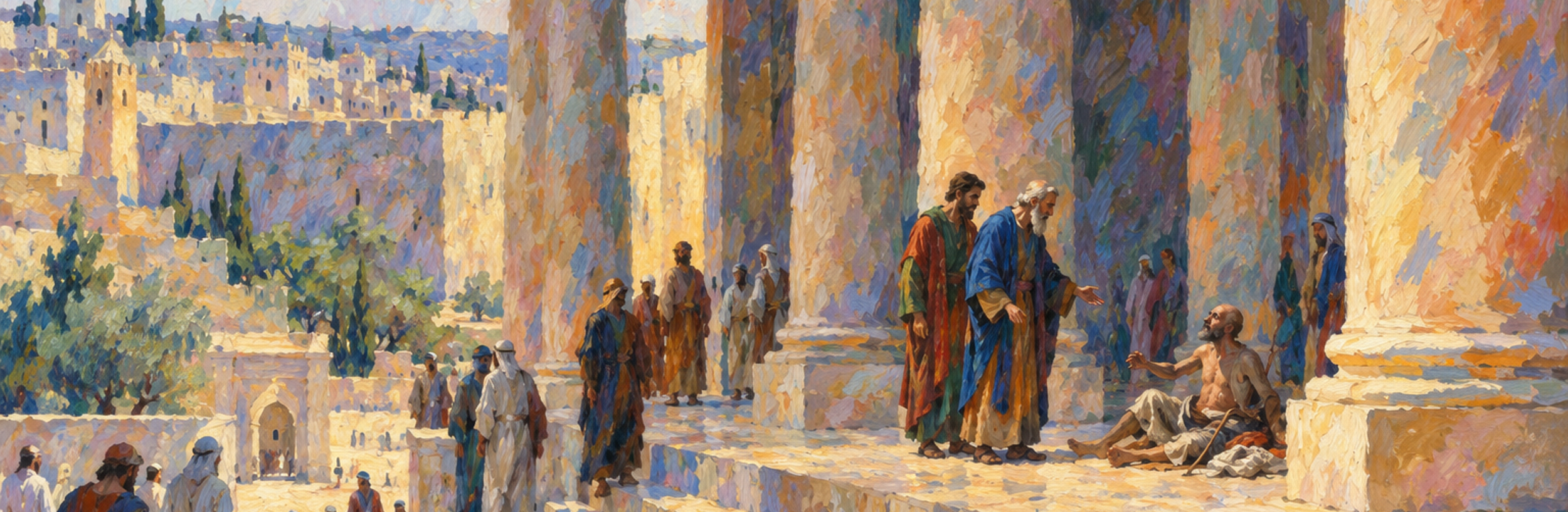
1 One day Peter and John were going up to the temple at the hour of prayer, at three o’clock in the afternoon. 2 And a man lame from birth was being carried in. People would lay him daily at the gate of the temple called the Beautiful Gate so that he could ask for alms from those entering the temple. 3 When he saw Peter and John about to go into the temple, he asked them for alms. 4 Peter looked intently at him, as did John, and said, “Look at us.” 5 And he fixed his attention on them, expecting to receive something from them. 6 But Peter said, “I have no silver or gold, but what I have I give you; in the name of Jesus Christ of Nazareth, stand up and walk.” 7 And he took him by the right hand and raised him up; and immediately his feet and ankles were made strong. 8 Jumping up, he stood and began to walk, and he entered the temple with them, walking and leaping and praising God. 9 All the people saw him walking and praising God, 10 and they recognized him as the one who used to sit and ask for alms at the Beautiful Gate of the temple; and they were filled with wonder and amazement at what had happened to him.
Acts 3:1-10
The Epistle reading for this Sunday in the Revised Common Lectionary is from Philippians Chapter 2, verses 1-13, but I decided to speak on the alternative text from the Acts of the Apostles. The first part, verses 1-10, deals with the healing of a man lame from birth. The second part, verses 11-19, involves the reaction not only of the man who was healed, but that of the crowd and of Peter himself:
11 While he clung to Peter and John, all the people ran together to them in the portico called Solomon’s Portico, utterly astonished. 12 When Peter saw it, he addressed the people, “You Israelites, why do you wonder at this, or why do you stare at us, as though by our own power or piety we had made him walk? 13 The God of Abraham, the God of Isaac, and the God of Jacob, the God of our ancestors has glorified his servant Jesus, whom you handed over and rejected in the presence of Pilate, though he had decided to release him. 14 But you rejected the Holy and Righteous One and asked to have a murderer given to you, 15 and you killed the Author of life, whom God raised from the dead. To this we are witnesses. 16 And by faith in his name, his name itself has made this man strong, whom you see and know; and the faith that is through Jesus has given him this perfect health in the presence of all of you.
17 “And now, friends, I know that you acted in ignorance, as did also your rulers. 18 In this way God fulfilled what he had foretold through all the prophets, that his Messiah would suffer. 19 Repent therefore, and turn to God so that your sins may be wiped out,
Acts 3:11-19
Peter wanted to make sure that the people understood that the healing power didn’t emanate from him, but that the man was healed in the name of Jesus, the Christ, the Messiah, whom the people in their ignorance rejected. It was this rejection, that resulted in the death but then the ultimate resurrection of Jesus that provided the healing not only of the man crippled from birth, but the healing power that would restore the people to a state of righteousness, wiping away their sin.
Remember that this man, Peter, was named Simon until his confession in his answer to the question of Jesus, “who do you say I am,” that Jesus was “the Messiah, the Son of the Living God.” It was then that Jesus said to Simon, “I tell you, you are Peter, and on this rock I will build my church.”
What did Jesus mean by this? There are various interpretations, but no absolute agreement on the subject.
I lean toward the understanding, based on the Greek words used in the Matthew’s Gospel, that Jesus meant that Peter was πέτρος (“petros” a small rock) and that Jesus would build his church on πέτρᾳ (“petra” a massive cornerstone) which in this instance referred to Jesus himself. This would be consistent with other Scripture, including 1 Corinthians 3:11 – “For no one can lay any foundation other than the one that has been laid; that foundation is Jesus Christ.”
My Mother’s Rock
I was raised Roman Catholic until I was around 15 and I joined Tupelo’s First Baptist Church. My mother was Catholic and my father was Baptist. I was therefore destined to marry a Methodist and here I am today.
My mother also joined First Baptist Church and for many years she was in charge of the nursery as “Aunt Norma” and also cooked most of the meals in the kitchen. On one occasion she was on a trip with either the youth or maybe some group of adults on their way to Gatlinburg when the bus was pulled over near a steep ravine above a stream. She talked Ricky Young, one of the pastors, into climbing down the steep slope to get her a rock.
Poor Ricky did as she asked, risking his limbs to fetch a stone from the water. When he got down there he started to pick up a rock, but my mother shouted, “not that one” and pointed to another. He finally picked up the one she wanted and brought it back to her and she kept it until the day she died last January.
Ricky spoke at her funeral and related the story of the rock, which he had up there on the pulpit with him. He told us that he knew my mother understood that the rock that meant the most to her, the rock she understood as the one upon which her faith rested was Jesus Christ.
I think Peter would have agreed. We gave that rock to Ricky, who understood as well.
Wilderness Rocks
While I’m on the subject of rocks, I should mention that I did give some thought to making the Old Testament lection the subject of this morning’s talk. It’s from the book of Exodus, the 17th chapter, verses 1-7:
1 From the wilderness of Sin the whole congregation of the Israelites journeyed by stages, as the LORD commanded. They camped at Rephidim, but there was no water for the people to drink. 2 The people quarreled with Moses, and said, “Give us water to drink.” Moses said to them, “Why do you quarrel with me? Why do you test the LORD?” 3 But the people thirsted there for water; and the people complained against Moses and said, “Why did you bring us out of Egypt, to kill us and our children and livestock with thirst?” 4 So Moses cried out to the LORD, “What shall I do with this people? They are almost ready to stone me.” 5 The LORD said to Moses, “Go on ahead of the people, and take some of the elders of Israel with you; take in your hand the staff with which you struck the Nile, and go. 6 I will be standing there in front of you on the rock at Horeb. Strike the rock, and water will come out of it, so that the people may drink.” Moses did so, in the sight of the elders of Israel. 7 He called the place Massah and Meribah, because the Israelites quarreled and tested the LORD, saying, “Is the LORD among us or not?”
The incident at the rock involved a kind of healing too – one that healed the people of their thirst, if not of their doubt and their complaining.
I also wanted to mention it because it involved another misunderstanding of the source of healing power.
It wasn’t the rock itself.
It wasn’t the staff of Moses.
It wasn’t Moses.
It was God.
A lesson we mustn’t forget. It was a lesson that Moses, one of the greatest prophets of the Old Testament, apparently did forget.
Exodus chapter 17 relates an incident early in the Israelites’ journey in the wilderness. On that occasion, God instructed Moses to strike the rock with his staff. Forty years on, as the people (a generation born in the wilderness) neared the end of their journey, we have another passage dealing with water and thirst. In Numbers, chapter 20, verses 1-13, the people were once again thirsting for water and complaining to Moses.
They were in the wilderness of Zin at a place called Kadesh. Miriam, Moses’ sister, had just died and been buried and perhaps that’s why Moses was in an angry mood, but when God instructed him to speak to the rock, he struck the rock twice with his staff instead.
God spoke to Moses and his brother, Aaron, and said, “Because you did not trust in me, to show my holiness before the eyes of the Israelites, therefore you shall not bring this assembly into the land that I have given them.”
This seems harsh to us, doesn’t it?
But Moses had disobeyed God.
At this point, he had been leading the people for more than 40 years – it must have been tempting to conflate his long leadership in both his confrontations with Pharoah and wandering in the wilderness, with power belonging to him rather than to God.
Moses was allowed to see the Promised Land from Mount Nebo before he died, and we know that he was ultimately united with God as he appeared along with Elijah during the transfiguration (Matthew 17:3)
Peter didn’t make that mistake when it came to the healing of the man lame from birth (although he made others, including wanting to remain with Jesus, Moses and Elijah on that mount of the transfiguration).
So, what is the lesson for us?
For me, the lesson is that we are not the ones in control. That has been our bent to sinning from the beginning.
It still is.
Peter’s advice holds true today. Repent – that is, turn from thinking we’re the ones in charge and turn instead to God, the source of the ultimate healing power.